
Going to Rameswaram? 7 Sacred Places You Shouldn’t Miss
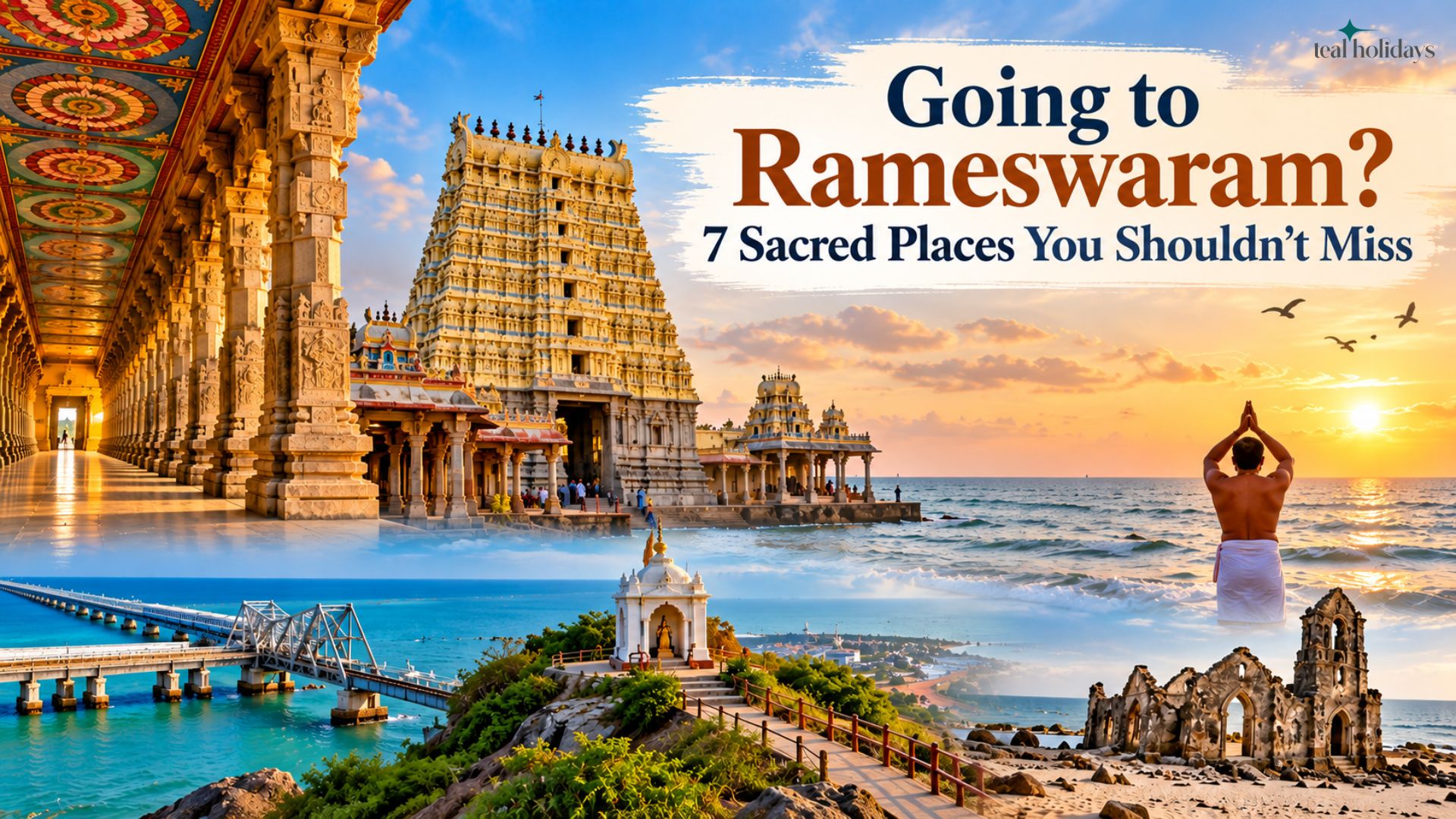
Rameswaram is one of those destinations where a journey feels like more than just a holiday.
Located on Pamban Island in Tamil Nadu, the town is deeply connected with Hindu pilgrimage traditions and the Ramayana. Pilgrims travel here to visit the famous Ramanathaswamy Temple, while other travellers come to experience its temples, sacred water bodies, coastal landscapes and the unique history surrounding the island.
But a trip to Rameswaram should not begin and end at one temple.
Several spiritually and culturally significant places are spread across Rameswaram and the surrounding region. Some are connected with stories from the Ramayana, some offer peaceful places for prayer, and others combine spirituality with unforgettable views of the sea.
If you are planning a Rameswaram trip, here are 7 sacred places you shouldn't miss.
1. Ramanathaswamy Temple
For most visitors, Ramanathaswamy Temple is the heart of a Rameswaram pilgrimage.
Dedicated to Lord Shiva, the temple is one of the twelve Jyotirlinga pilgrimage sites and holds enormous religious importance. It is also closely associated with the Ramayana and the story of Lord Rama worshipping Shiva.
Apart from its spiritual significance, the temple is known for its impressive Dravidian architecture and long pillared corridors.
One of the important traditions associated with a visit is bathing in the sacred theerthams. The temple complex contains 22 sacred wells, and pilgrims traditionally bathe using water drawn from these wells before proceeding for darshan.
If this is your first trip to Rameswaram, give yourself enough time here instead of trying to squeeze the visit into a rushed itinerary.
Why visit: Jyotirlinga pilgrimage, temple architecture, sacred theerthams and spiritual significance.
2. Agni Theertham
Located close to Ramanathaswamy Temple, Agni Theertham is one of Rameswaram's most important sacred bathing places.
Unlike many temple theerthams located within a complex, Agni Theertham is situated along the seashore.
Pilgrims traditionally take a holy dip here before visiting Ramanathaswamy Temple. The calm sea, temple surroundings and early-morning atmosphere make the area feel very different from an ordinary beach.
Even if you are not participating in the religious rituals, visiting early in the morning gives you an opportunity to experience an important part of Rameswaram's pilgrimage culture.
The sunrise over the sea can also make the visit especially memorable.
Why visit: Sacred sea bathing, pilgrimage traditions and peaceful early-morning views.
3. Panchamukhi Hanuman Temple
Another important spiritual stop in Rameswaram is the Panchamukhi Hanuman Temple, dedicated to the five-faced form of Lord Hanuman.
The five faces traditionally represent Hanuman, Narasimha, Garuda, Varaha and Hayagriva.
The temple attracts devotees because of its association with Lord Hanuman and the Ramayana. It is also known for displaying stones traditionally associated with the story of the floating stones used during the construction of Rama Setu.
Whether you visit for religious reasons or because you are interested in the Ramayana stories connected with Rameswaram, this temple can be included conveniently alongside other important sites in town.
Why visit: Lord Hanuman worship, Ramayana connections and traditional floating-stone displays.
4. Gandhamadhana Parvatham
If you want a sacred place that also provides a different view of Rameswaram, visit Gandhamadhana Parvatham.
Situated on an elevated location, it is traditionally associated with Lord Rama and is considered an important pilgrimage site. The shrine here is known for footprints believed by devotees to represent Lord Rama's feet.
The elevated setting also provides panoramic views over parts of Rameswaram Island.
After spending time inside large temple complexes, Gandhamadhana Parvatham offers a quieter experience. The combination of spiritual significance and surrounding views makes it worth including in a Rameswaram itinerary.
Why visit: Association with Lord Rama, sacred footprints and panoramic island views.
5. Kothandaramaswamy Temple
The journey towards Dhanushkodi takes you through a landscape where the sea seems to appear on every side.
Along this route stands Kothandaramaswamy Temple, a temple associated with an important episode from the Ramayana.
According to tradition, this area is connected with Vibhishana, the brother of Ravana, seeking refuge with Lord Rama. The temple therefore carries special significance for devotees following the Ramayana trail through Rameswaram.
Its location is equally memorable.
Surrounded by a quiet coastal landscape away from the busiest parts of town, the temple has a peaceful atmosphere that makes the journey itself part of the experience.
If you are already planning to visit Dhanushkodi, Kothandaramaswamy Temple is an important stop along the way.
Why visit: Ramayana history, Vibhishana connection and serene coastal surroundings.
6. Dhanushkodi and Arichal Munai
Dhanushkodi is unlike almost anywhere else you will visit during a Rameswaram trip.
Once a functioning town, much of Dhanushkodi was destroyed during the devastating 1964 cyclone. Today, the area's ruins and dramatic coastal geography have made it one of the most visited places near Rameswaram.
But Dhanushkodi is not significant only because of its history.
The region is closely associated in Hindu tradition with Rama Setu, the legendary bridge connected with Lord Rama's journey towards Lanka.
Further along the route lies Arichal Munai, near the eastern end of the accessible land.
Standing there with the sea stretching towards the horizon gives the journey an entirely different feeling. The landscape is open, powerful and surprisingly peaceful.
Because access conditions can depend on weather and local restrictions, travellers should check current timings and road access before travelling towards the endpoint.
Why visit: Rama Setu traditions, Dhanushkodi history, coastal scenery and Arichal Munai.
7. Devipattinam Navagraha Temple
If your itinerary allows some travel beyond Rameswaram town, Devipattinam is another spiritually significant destination worth considering.
The place is famous for the Navagraha stones located in the sea, traditionally known as Navapashanam.
According to local religious tradition, Lord Rama worshipped the nine planetary deities here before continuing his journey towards Lanka.
During suitable sea conditions, devotees can see the stone structures standing in shallow water and perform prayers connected with the Navagrahas.
Devipattinam can be especially relevant for travellers planning a broader pilgrimage itinerary covering Rameswaram and other sacred destinations in Ramanathapuram district.
Why visit: Navagraha worship, association with Lord Rama and a distinctive seaside pilgrimage experience.
How Many Days Do You Need for Rameswaram?
While it is possible to see some major attractions in a single day, 2 days is much more comfortable for most Rameswaram trips.
On the first day, you can focus on Ramanathaswamy Temple, Agni Theertham, Panchamukhi Hanuman Temple and Gandhamadhana Parvatham.
The second day can be reserved for Kothandaramaswamy Temple, Dhanushkodi and Arichal Munai. Travellers with additional time can include Devipattinam or combine Rameswaram with other pilgrimage destinations in Tamil Nadu.
Starting early is particularly useful because temple visits, rituals, crowds and travel times can make a rushed itinerary tiring.
A Rameswaram Journey Is About More Than Visiting Places
Rameswaram brings together mythology, faith, architecture, history and the sea in a way few destinations can.
You may begin the journey wanting to visit Ramanathaswamy Temple, but the smaller temples, sacred theerthams, quiet roads towards Dhanushkodi and stories associated with each location often become equally memorable.
The best way to experience Rameswaram is therefore not to rush from one attraction to another.
Give yourself time to understand why each place matters.
Whether you are travelling with family, elderly parents or as part of a larger spiritual tour, planning the route properly can make the pilgrimage much more comfortable.
Plan Your Rameswaram Trip With Teal Holidays
Want to experience Rameswaram without worrying about transportation, sightseeing routes and travel planning?
Teal Holidays can help you plan a comfortable Rameswaram tour covering important temples, sacred sites and nearby attractions based on your travel schedule.
From family pilgrimage trips to customised Tamil Nadu temple tours, we can help organise the journey so you can spend less time managing logistics and more time experiencing the destination.